Emerging biopharma companies originated 65% of new active medicines launched worldwide from 2020 to 2024, and filed for nearly half of U.S. launches in that period.1
Larger pharmaceutical companies often make that decision within the boundaries of what they already have: legacy device platforms, established supplier relationships, existing assembly lines and internal device teams built around a particular approach. Emerging pharma companies generally do not carry that history. That gives them an opportunity many larger organizations may not have: to choose the delivery system that best fits the drug, the patient and the commercial plan, rather than the one that fits the past.
The Opportunity to Leapfrog the Status Quo
For many years, the conventional route to needle safety on a prefilled syringe has been an add-on safety device: an external housing, sleeve or spring-loaded “exoskeleton” assembled around the filled syringe. It generally works. But it adds a separate complex device from a separate supplier, it has the risk of premature activation which prevents delivery of the drug, it creates sustainability challenges and adds an additional post-fill assembly step to every unit produced.
A company that has not yet committed to an add-on safety platform does not need to treat that architecture as the default. It can consider integrated passive needle safety from the outset, where the safety mechanism is built into the syringe system itself and activates automatically at the end of the injection. That is the leapfrog opportunity: to bypass a layer of complexity that others inherited and begin by implementing an advantageous solution.
Credence’s earlier blog on 3 mL and 5 mL prefilled syringes explains the mechanics of integrated and passive safety in detail.2 This article focuses on why the decision matters most, and pays off most, for emerging pharma programs.
Make the Delivery-System Decision Earlier
It is understandable that a lean emerging pharma team puts the molecule first. Clinical milestones, financing and regulatory strategy compete for limited time and people, and the commercial delivery system can feel like a problem for later.
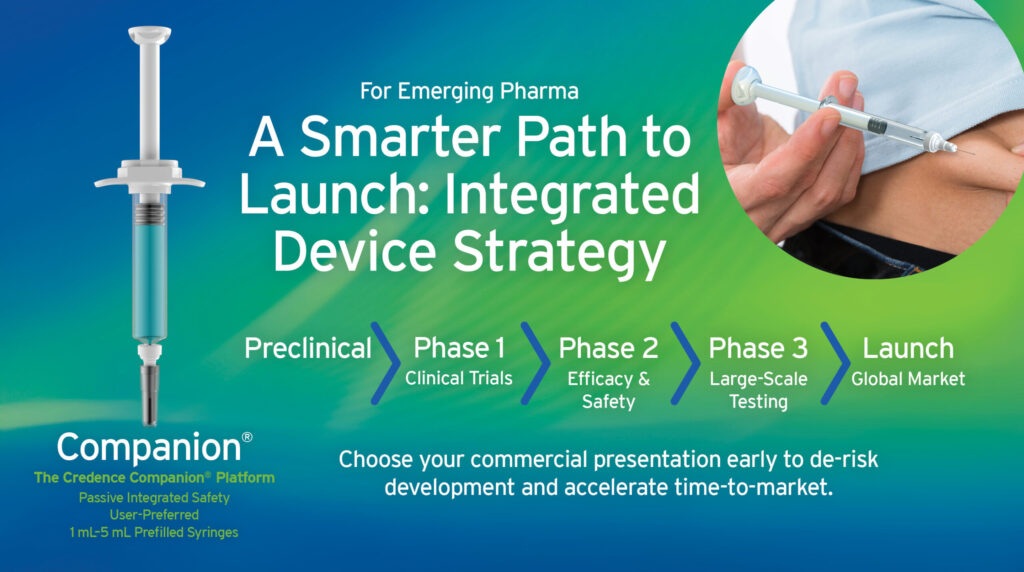
The regulatory picture suggests otherwise. FDA’s draft guidance on bridging for drug-device and biologic-device combination products encourages sponsors to conduct clinical studies with the delivery system intended for commercialization. When clinical data are generated with the final finished combination product, bridging to earlier clinical data is not needed.3 When the presentation changes, sponsors must assess the differences and may need additional data to bridge them.
Start with the Intended Commercial Presentation
If a prefilled syringe is part of the intended commercial presentation, there is real value in choosing the syringe, safety system and manufacturing pathway with that end point in mind. Doing so early can help avoid revisiting device decisions, repeating studies or rebuilding supply arrangements as the program advances toward registration.
Consider Whether an Autoinjector Is Necessary
Early planning also creates room to question assumptions. Autoinjectors are often chosen to make self-injection simpler and safer, but they add cost, components and development effort. FDA’s bridging guidance uses the example of adding an autoinjector around an existing prefilled syringe and notes that the sponsor may need human factors validation data, design verification and validation data, and an assessment of pharmacokinetic effects.3
For some programs, a prefilled syringe with intuitive usability and passive integrated needle safety may meet the needs of the intended users without an autoinjector at all. Where that is the case, the program can avoid an entire device layer, along with its development time, cost and supply-chain burden. If an autoinjector presentation is envisioned, either at launch or as a life cycle development program after launch, a prefilled syringe with passive integrated safety can vastly simplify the autoinjector that is chosen. An integrated safety system allows for two presentations: One as a prefilled syringe and one in an autoinjector.
Keep the Commercial Supply Chain Simple
For a lean organization, every additional component in the commercial supply chain carries ongoing cost. An add-on safety device typically means another device to qualify, another supplier to manage, another inventory position and another post-fill assembly operation, often at a contract manufacturer.
The Credence Companion® Platform integrates the needle safety mechanism into the syringe system. Syringes arrive pre-sterilized and ready for filling in industry-standard tubs, so there is no need to disrupt the filling process, and secondary assembly is simplified.4 The platform is compatible with a wide range of glass and polymer barrels, plunger stoppers, needle shields and siliconization treatments, allowing companies to select components based on application requirements or sourcing preferences.4
This is Innovation Without Change® in practice. Proven primary components and established fill-finish infrastructure stay in place, while the safety and usability capability is built into the syringe system rather than added on afterward.
Why Integrated Safety Matters More at Larger Volumes
Dose volumes are rising across many injectable therapies, and with them, syringe sizes. The Companion® Platform covers industry-standard 1 mL Long, 2.25 mL, 3 mL and 5 mL formats.6
With an add-on approach, a larger syringe needs a larger external safety structure around it, adding material, size, cost and handling burden. With integrated safety, the protection is part of the syringe architecture at every volume, and the passive mechanism is consistent across the platform. The value of integrated safety is amplified as syringe sizes increase; these advantages include cost, usability, manufacturing efficiency and sustainability. For an emerging pharma company with more than one program, or one product that may move to a larger dose over its lifecycle, that consistency can simplify development, sourcing and supply.2
Designed for the User
Patients, caregivers and healthcare professionals all benefit when a safety syringe works like a familiar syringe. With the Companion® Platform, the needle retracts automatically into the syringe barrel after injection, disabling the syringe and preventing reuse. Audible, tactile and visual cues confirm that the dose has been delivered and the safety feature has engaged.4,5 This aligns with FDA’s long-standing guidance that users should be able to tell easily whether a sharps-injury-prevention feature has activated.7
In formative human factors studies with experienced nurses published in Drug Development & Delivery, participants gave the Companion® Staked Needle Safety Syringe high acceptance across ease of use, safety cues and ergonomics, and preferred it to the conventional approach of an add-on safety device.5
Credence as an Extension of Your Device Team
Emerging pharma companies often have lean internal device and combination-product teams, and fewer layers of internal process to slow decisions. That combination can be an advantage, provided the right expertise is available when it is needed.
Credence works with emerging pharma partners as more than a technology supplier. As programs advance, Credence can serve as an extension of the device development team, providing guidance and support in areas such as:
- Prefilled syringe and primary component selection.
- Device development and design history file (DHF) documentation.
- Human factors and usability planning.
- Regulatory activities for the combination product.
- Fill-finish, assembly and supply-chain pathways toward commercial readiness.
Credence’s recent ISO 13485 certification is a key milestone in its progression toward ready-to-supply partnerships, supporting the quality system expectations of pharmaceutical partners.6
Why Credence MedSystems
Credence MedSystems solves injectable drug delivery challenges for pharmaceutical and biotechnology companies through ready-to-supply platform technologies, designed around the needs of patients and built for the realities of pharmaceutical development and manufacturing. The Companion® Platform delivers passive integrated needle safety and user-preferred drug delivery across industry-standard 1 mL to 5 mL prefilled syringes.
For emerging pharma, the opportunity is broader than needle safety alone. It is the chance to make informed commercial delivery-system decisions earlier, leapfrog legacy approaches, simplify the path to commercial supply and access device-development expertise that may not exist in-house. Through Innovation Without Change®, Credence helps partners do that while minimizing implementation risk and operational disruption.
If you are planning the commercial presentation for an emerging pharma injectable program, meet with Credence to discuss your drug delivery challenge and explore platform compatibility with the Companion® Platform.
Frequently Asked Questions
What is an integrated needle safety syringe?
It is a prefilled syringe system in which the needle-safety mechanism is built into the syringe rather than added as a separate external device. In the Companion® Platform, the needle retracts passively into the barrel after injection and the syringe is disabled to prevent reuse.4
Why should emerging pharma companies choose a delivery system early?
FDA encourages sponsors to conduct clinical studies with the delivery device intended for commercialization. Selecting the likely commercial presentation early can reduce the need to bridge data or revisit device decisions later in development.3
Can a safety prefilled syringe replace an autoinjector?
For some programs, yes. Where a prefilled syringe with intuitive usability and passive integrated safety meets the needs of intended users, it may avoid the added development, cost and supply-chain burden of an autoinjector. The decision should be supported by human factors evaluation for the intended users and use environment. If an autoinjector is needed, an integrated safety system allows for two presentations: One as a prefilled syringe and one in an autoinjector.
Does integrated needle safety require changes to fill-finish?
Not with the Companion® Platform. Syringes are supplied pre-sterilized in industry-standard tubs, work with established filling processes and require only the addition of the Companion® plunger rod during secondary assembly.4
What syringe sizes does the Companion® Platform support?
The Companion® Platform covers industry-standard 1 mL, 2.25 mL, 3 mL and 5 mL prefilled syringe formats.6
Can Credence support companies without large internal device teams?
Yes. Credence can support PFS and component selection, device development, DHF documentation, human factors and regulatory activities as an extension of a partner’s device team.
Sources
1. IQVIA Institute for Human Data Science. “Expanding Options for Emerging Biopharma in the U.S.: A Decade of Change.” October 29, 2025. https://www.iqvia.com/insights/the-iqvia-institute/reports-and-publications/reports/expanding-options-for-emerging-biopharma-in-the-us-a-decade-of-change
2. Credence MedSystems, Inc. “3 mL and 5 mL Prefilled Syringes: How Integrated Needle Safety Improves Usability, Sustainability, and Total Cost of Ownership.” August 2026. https://www.credencemed.com/3-ml-and-5-ml-prefilled-syringes-how-integrated-needle-safety-improves-usability-sustainability-and-total-cost-of-ownership/
3. U.S. Food and Drug Administration. “Bridging for Drug-Device and Biologic-Device Combination Products: Draft Guidance for Industry.” December 2019. https://www.fda.gov/media/133676/download
4. Credence MedSystems, Inc. “Companion® Product Family: Staked Needle Syringe.” https://www.credencemed.com/staked/
5. Merhige, John A., and Lisa Caparra. “The Credence Companion Syringe System Delivers on Safety & Usability Using Human Factors Studies.” Drug Development & Delivery, October 2015, Vol. 15, No. 8. https://www.credencemed.com/wp-content/uploads/2014/08/DDD-October-2015-Credence-Companion-and-HF-Studies-Low-Res.pdf
6. Credence MedSystems, Inc. “Credence MedSystems Achieves ISO 13485 Certification, Marking Key Milestone Towards Ready-to-Supply Partnerships.” September 29, 2026. https://www.floridatoday.com/press-release/story/166784/credence-medsystems-achieves-iso-13485-certification-marking-key-milestone-towards-ready-to-supply-partnerships/
7. U.S. Food and Drug Administration. “Medical Devices with Sharps Injury Prevention Features: Guidance for Industry and FDA Staff.” August 9, 2005.