Intravitreal Injections: How Dose-Assist Devices Support Safer, More Accurate Drug Delivery
Intravitreal biologics and other therapies have transformed the treatment of retinal disease, but they have also concentrated significant clinical stakes into a single, sub-100-microliter injection. Unlike a subcutaneous or intramuscular dose, an intravitreal injection is delivered directly into a small, delicate, and largely incompressible compartment of the eye, where even small variability in delivered volume, residual air, or plunger motion can affect patient safety, comfort, and treatment outcome.
For pharmaceutical and biotechnology companies developing ophthalmic biologics, the prefilled syringe is therefore more than a delivery vehicle, it is effectively part of the therapy. As more anti-VEGF agents, gene therapies, and next-generation ophthalmic biologics move through development, drug-delivery teams are re-examining how syringe design can reduce dosing variability and patient risk without disrupting proven primary packaging or established fill-finish processes.
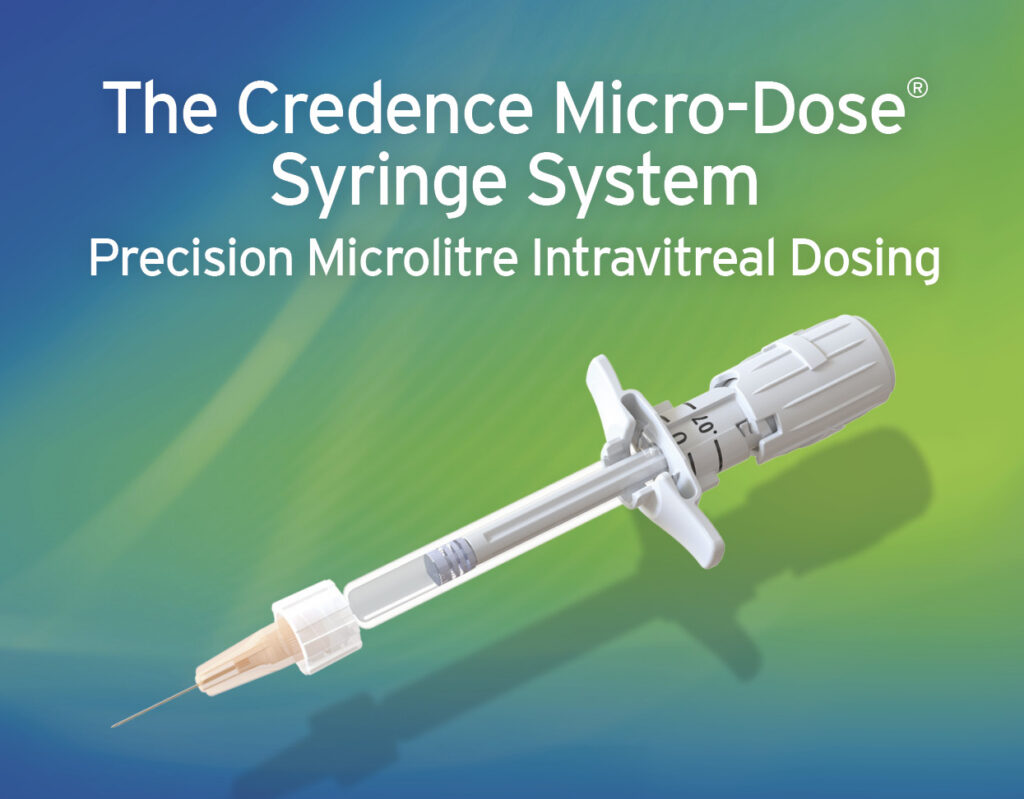
The Credence Micro-Dose® Syringe Platform was purpose-built around these requirements. Rather than replacing a pharma company’s chosen prefilled syringe, Micro-Dose® is a precision-dosing attachment that assembles onto standard prefilled syringes after filling, adding mechanically guided air removal and dose delivery in support of precision, safety, and efficacy for intravitreal therapies.1
Solving the Intravitreal Drug Delivery Challenge
Intravitreal injection volumes are unusually small, commonly in the 50 µL range for many approved therapies, and lower still for some newer or investigational agents.2 At these volumes, a small absolute dosing error represents a comparatively large percentage error, which is why precision dosing is the foundational design requirement for any intravitreal delivery system: it helps the clinician avoid overdosing and its associated safety concerns, as well as underdosing, which can compromise therapeutic efficacy.
Precision Dosing, By Design
Micro-Dose® uses a defined mechanical hard stop to set the limit of plunger travel, so the delivered dose is determined by the design of the device itself rather than by a clinician visually aligning the plunger with a printed graduation line on the syringe barrel.2 This is intended to reduce a source of dosing variability that is otherwise dependent on user technique, particularly important given how little margin low-volume ocular dosing allows.
Plunger Recoil and the Risk of Vitreous Backflow
A less visible risk in conventional syringe use is the elastic recoil of the syringe stopper. Published research using standard prefilled syringes found that when a clinician applies additional plunger force and then releases it, the stopper’s elastic rebound can draw fluid, and potentially vitreous, back into the needle, a mechanism the authors observed produces a visible air bubble when it occurs outside the eye.3 The study’s authors specifically caution that this recoil effect, if it occurs while the needle remains within the vitreous cavity, could contribute to vitreous incarceration and place traction on the retina during needle withdrawal, and they recommend that excessive plunger force be avoided and that pressure not be released until after the needle has cleared the eye.3
Micro-Dose®’s mechanism of action is designed to address this risk directly. Because the dose-delivery motion is guided mechanically to a defined hard stop rather than relying on the clinician modulating and then releasing thumb pressure, the design is intended to reduce the plunger-recoil dynamics associated with conventional syringe use and the associated risk of vitreous backflow.
Controlled Air Removal and Patient Comfort
Removing air from a syringe before intravitreal injection is a routine but consequential step. Air injected into the eye can cause significant patient pain, and conventional manual debubbling requires the clinician to overcome the syringe’s break-loose force while judging by eye how much air remains, a process that can also lead to inadvertent drug spillage.2 At intravitreal volumes, the loss of even a small quantity of drug during debubbling can meaningfully underdose the patient.2
Micro-Dose® replaces this manual judgment with a mechanically controlled sequence. The clinician twists the device’s safety cover to prime the syringe, an action that purges the air bubble to a defined hard stop; the thumb pad is then revealed and pressed to deliver the dose to a second, independent hard stop.2 This two-stage, hard-stop design is also intended to guard against premature injection, since the dose-delivery step only becomes available once priming is complete.
Designed for the User: A Trusted Tool for the Clinician
For the retinal specialist, the value of any intravitreal delivery device is measured against a simple standard: does it make an already precise, time-pressured procedure more controlled, repeatable, and efficient, without adding complexity to an established workflow? The Micro-Dose® Platform is designed to add that value while integrating into the procedure clinicians already know.
A Guided, Repeatable Sequence
The mechanically guided sequence is intended to remove areas of variability from the procedure in two stages. First, the controlled twisting action that primes the device and purges air is designed to help overcome the higher break-loose forces that can result from the low- or no-silicone syringes increasingly preferred for ophthalmic use. Second, during dose delivery, the clinician presses the thumb pad to a defined hard stop, removing the need to manually judge dosing against printed syringe graduation lines during the injection itself.
Addressing the Silicone Trade-off
Silicone oil has long served as a lubricant that helps a syringe plunger glide smoothly, but its use in intravitreal syringes carries a well-documented downside: agitation, transport, and even the injection process itself can release silicone oil droplets into the eye, where they may cause visible floaters and, in some published research, have been associated with post-injection ocular inflammation.4 This has led ophthalmic specialists and syringe manufacturers to increasingly favor low-silicone or silicone-oil-free syringe designs, and manufacturer safety notices have recommended using syringes and needles specifically labeled for intravitreal use to help reduce this risk.5
The trade-off is that reduced or specialized siliconization typically raises the break-loose and glide forces a clinician must overcome to operate the syringe, which can make an injection feel less consistent from procedure to procedure.5 Micro-Dose® is designed to address both sides of this tension at once: its mechanically guided priming step is engineered to help overcome the elevated break-loose forces associated with low-silicone syringes, allowing pharma companies to pursue reduced-silicone or specialized siliconization strategies for patient safety without asking the clinician to absorb a corresponding increase in procedural difficulty.
Supporting Procedural Efficiency
Because Micro-Dose® eliminates the need to manually approximate a dose against a printed line and shifts priming and preparation into a controlled mechanical sequence, an assistant or technician may be able to prepare the system in advance of the retinal surgeon’s involvement. This division of labor is intended to allow the surgeon to focus more fully on the injection itself, an efficiency consideration that could matter increasingly as intravitreal injection volumes continue to rise across anti-VEGF and other retinal therapy classes.
Built for Pharma: Practical Integration Across the Supply Chain
For a pharmaceutical or biotechnology manufacturer, a delivery device’s value is not confined to the injection room. A device that offers a meaningful, demonstrable advantage over the current standard of care can become an important source of product differentiation, supporting adoption, market share, and, ultimately, commercial success in an increasingly competitive intravitreal therapeutic landscape.
Compatibility Without Disruption
The Micro-Dose® Platform is designed to deliver that differentiation without requiring a pharma partner to re-engineer its existing drug-product supply chain. The platform supports compatibility with different prefilled syringe and stopper configurations, and because it is assembled onto the syringe after filling, it leaves the aseptic filling process itself completely unchanged.1 It also avoids the need for syringes with printed dose-graduation lines and is engineered with sterilization integrity in mind: Micro-Dose®’s mechanism is designed to help prevent retrograde motion of the plunger during terminal sterilization, addressing a potential route to a break in sterility of the drug product.
Because it is added post-fill, Micro-Dose® also supports specialized siliconization approaches chosen for patient safety, including reduced-silicone or baked-on siliconization strategies, without requiring the pharma company to alter validated primary packaging or filling-line qualification.1
From Molding to Post-Fill Assembly
Credence’s understanding of pharmaceutical manufacturing spans the full supply chain: from initial design and development, through molding and component manufacture, to post-fill secondary assembly, labeling, and packaging. That end-to-end perspective is intended to help pharma partners implement a differentiated delivery experience for clinicians and patients while minimizing new validation burden, new supplier relationships, or new risk introduced into an already-approved manufacturing pathway.
Innovation Without Change® Ties It Together
Precision, safety, and efficacy for the therapy and patient; a genuinely useful tool for the clinician; and practical, low-disruption implementation for pharma, these three outcomes are the result of Credence’s Innovation Without Change® philosophy. Rather than asking pharmaceutical companies to choose between innovation and operational continuity, Innovation Without Change® is built on the premise that meaningful drug-delivery advances should work with proven primary components and established manufacturing processes, not against them.
For intravitreal drug delivery specifically, that philosophy translates into a device that gives the clinician confidence and control, gives the patient a lower-risk, more comfortable procedure, and gives the pharma manufacturer a differentiated system that fits into the process it has already validated.
Why Credence MedSystems
Credence MedSystems is an industry-recognized innovator in injectable drug delivery, developing platform technologies designed around the needs of patients and built for the realities of pharmaceutical development and manufacturing.6 The Micro-Dose® Syringe Platform extends that platform approach to ocular and intravitreal delivery, adding precision micro-dosing and controlled air purging to standard prefilled syringes without disrupting a manufacturer’s existing primary package or fill-finish investment.1
If you are developing an intravitreal or other low-volume ophthalmic injectable program, talk to Credence about how the Micro-Dose® Syringe Platform will support precision, safety, and clinician confidence in your delivery strategy.
Frequently Asked Questions
What is the Micro-Dose® Syringe System?
Micro-Dose® is a precision-dosing device designed for ocular and intravitreal injections. It assembles onto a standard prefilled syringe after filling and provides mechanically guided air removal and dose delivery to defined hard stops, supporting precise low-volume dosing.1
Why does dosing precision matter so much for intravitreal injections?
Intravitreal doses are commonly delivered in the 50 µL range or lower, so even small absolute variations in delivered volume represent comparatively large percentage errors. Precision dosing helps protect against both overdosing, which raises safety concerns, and underdosing, which can compromise treatment efficacy.2
How does Micro-Dose® address the risk of vitreous backflow?
Conventional syringe use can involve manually applying and releasing plunger force, and published research shows that the resulting elastic recoil of the syringe stopper can draw fluid, and potentially vitreous, back into the needle, a mechanism researchers link to a risk of vitreous incarceration.3 Micro-Dose®’s hard-stop delivery mechanism is designed to reduce reliance on this kind of manual force modulation.
Does Micro-Dose® help with air-related patient pain?
Yes. Air injected into the eye can cause significant patient pain.2 Micro-Dose® guides air removal through a controlled twist-to-prime action rather than manual debubbling, which is intended to reduce both the risk of injecting air and the drug spillage that can accompany conventional debubbling.2
Does using Micro-Dose® require pharma companies to change their existing syringe or fill-finish process?
No. Micro-Dose® is designed to support compatibility with different prefilled syringe and stopper configurations and is assembled post-fill, leaving the filling process unchanged. It is intended to support pharma companies pursuing specialized siliconization approaches without new primary packaging validation.1
Can Micro-Dose® support low-silicone or silicone-free ophthalmic syringes?
Yes. Reduced- or no-silicone syringes are increasingly favored in ophthalmology to help limit silicone oil droplets in the eye, but they typically require higher break-loose and glide forces.4,5 Micro-Dose®’s mechanically guided priming step is designed to help overcome these elevated forces, supporting the clinician while enabling the safety-focused syringe choice.
Sources
- Credence MedSystems, Inc. “Micro-Dose® Syringe System.” https://www.credencemed.com/micro-dose-syringe-system/
- Dubin, Cindy H. “Injection Devices: Wearables, Connectivity & Patient-Centric Designs Empower Self-Administration” (featuring John A. Merhige, Credence MedSystems). Drug Development & Delivery, September 2019, Vol 19 No 6. https://www.credencemed.com/wp-content/uploads/2020/01/Article-B-Micro-Dose.pdf
- Raevis, Joseph J., Colin A. Lemire, David J. Ramsey, James Riccobono, and Efren Gonzalez. “Deformation of Aflibercept and Ranibizumab Syringes Causes Variation in Intravitreal Injection Volume and Risks Retinal Tear Formation.” Ophthalmology Science, July 15, 2022. https://pmc.ncbi.nlm.nih.gov/articles/PMC9754977/
- Melo, Gustavo B., et al. “The Risks Behind the Widespread Use of Siliconized Syringes in Ophthalmology.” International Journal of Retina and Vitreous, October 30, 2021. https://pmc.ncbi.nlm.nih.gov/articles/PMC8557543/
- “Exploring Syringe Selection for Intravitreal Injections.” Retinal Physician, October 2021. https://retinalphysician.com/issues/2021/october/exploring-syringe-selection-for-intravitreal-injections/