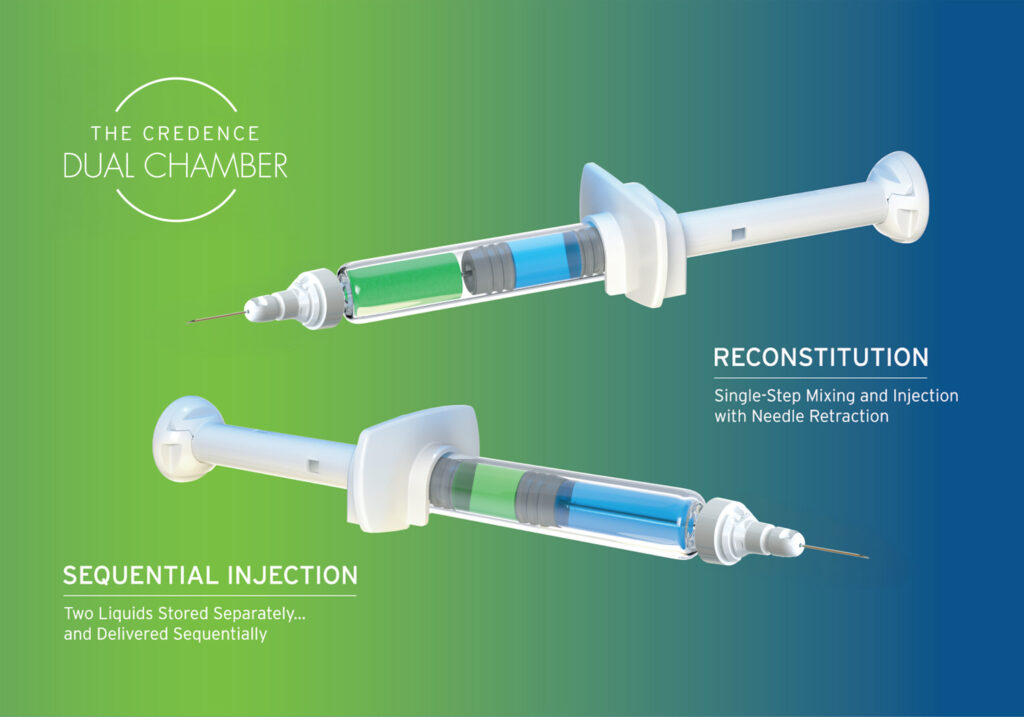
A promising injectable therapy can clear its safety and efficacy hurdles and still stall on a question that often arrives too late: how will it actually be delivered? When a molecule cannot remain stable in liquid form, or when two drug components cannot be co-formulated, the delivery strategy becomes critical. A lyophilized product may need to be reconstituted before use, while two incompatible liquids may need to be delivered sequentially.
Too often, the device is selected once drug development has progressed too far. That sequence can build in risk which is otherwise avoidable. Formulation, primary container, device, user needs, fill-finish and commercial manufacturing are interconnected, and a decision made in one area sets constraints for all the others. FDA guidance on early development considerations for innovative combination products reflects the same reality: device questions belong in the earliest stages of development, not at the end.1
The more productive question is not “Which device fits this drug?” but “What does this drug require, and which delivery strategy meets those requirements without creating new problems elsewhere?”
Let the Drug Determine the Delivery Strategy
Every injectable program carries nonnegotiable drug product requirements: stability, compatibility with contact materials, dose, volume, viscosity, route of administration and the setting in which the product will be used. Those requirements, rather than device preference or legacy habit, should determine the delivery strategy.
Evaluating delivery options early allows CMC, formulation, device, human factors, fill-finish and commercial teams to see trade-offs while they can still be managed. It also helps teams identify the real challenge. In many complex programs, the challenge is not the formulation itself but the delivery problem the formulation creates.
When Liquid Stability Is the Barrier
Developing a stable liquid formulation can be one of the most significant challenges for complex injectable therapies. Some molecules degrade in solution over a commercially relevant shelf life; others are stable only as lyophilized powders. Depending on the formulation, some lyophilized products can remain stable for two to three years, but the conventional vial-based presentation shifts complexity to the point of use.2
When a formulation cannot achieve the required stability in liquid form, the default response is often more formulation work: further excipient screening, new buffer systems and extended stability studies. Sometimes that is the right path. It is not the only one, and it can consume significant time and investment without a guaranteed result.
Another Path: Keep Constituents Separate Until Administration
Dual chamber delivery offers a different approach. Rather than requiring every constituent to coexist in a single liquid throughout shelf life, a dual chamber syringe keeps them separate during storage and brings them together only when required for administration.
This distinction matters. A dual chamber system does not make a formulation less complex, and it does not replace sound formulation science. What it can do is solve the delivery challenge created by the drug product’s requirements, giving CMC and formulation teams a path forward while minimizing disruption to the primary container and manufacturing process.
Two Distinct Use Cases: Reconstitution and Sequential Delivery
“Dual chamber” is often used as a single category, but it covers two different drug delivery challenges. Each brings its own requirements for chamber design, user steps, human factors evaluation and fill-finish.
Reconstitution, Including Lyophilized Therapies
In a conventional vial-kit presentation, the user draws diluent from one vial, adds it to the vial containing the lyophilized drug, withdraws the reconstituted product, changes the needle and then administers the dose.2 Each step is an opportunity for error and risk. Published analyses of two-component products describe errors such as administering only the diluent, administering only one active component or reconstituting with the wrong diluent.3 A 2026 review in Antibody Therapeutics notes that a European Medicines Agency assessment of leuprorelin depot medicines documented 169 medication errors associated with one product’s reconstitution system, with the mixing step the largest single category.4
Vial kits also carry a material and cost burden. Multiple vials, syringes, needles, adapters and swabs add waste, and a 1 mL vial can require 20% or more overfill to ensure an accurate dose can be withdrawn.2
A dual chamber reconstitution syringe stores the lyophilized powder or liquid constituent in the front chamber and the diluent in the rear chamber, mixing them within the syringe at the point of use.5 The Credence Dual Chamber Syringe System supports liquid-liquid reconstitution, lyo-liquid reconstitution and powder-liquid reconstitution. 6
Sequential Delivery of Two Liquids
Sequential delivery addresses a different requirement, incompatibility between two liquids that must be administered together. Here, two liquids must remain separate before administration and are delivered one after the other in a single injection, rather than mixed. The Credence Dual Chamber Sequential Syringe delivers both liquids with a single press of the plunger rod, avoiding co-formulation efforts and reducing preparation time and the potential for error.5
Treating reconstitution and sequential delivery as the same problem can lead to the wrong device requirements; treating them as distinct use cases helps teams specify the right solution from the start.
Reducing Development Risk Without Trading One Problem for Another
Reducing development risk is less about eliminating every unknown than about avoiding solutions that move risk from one function to another. Three tests are useful for any complex injectable program:
- A formulation decision should not create an unacceptable delivery challenge.
- A device solution should not require unnecessary changes to proven primary components or established fill-finish processes.
- A technically strong solution must still allow the user to administer medication properly and safely, and be manufacturable, scalable and commercially viable.
These tests map directly to the three pillars of the Credence approach.
Solve the Drug Delivery Challenge
The starting point is the drug product: its formulation, stability, compatibility, dose and administration requirements. Where liquid stability or co-formulation is the barrier, dual chamber delivery can turn a difficult pipeline decision into a delivery strategy, without assuming the molecule must be reformulated to fit a conventional presentation.
Designed for the User
A dual chamber product is only successful if reconstitution or sequential delivery is intuitive for the people who use it, increasingly patients and caregivers at home. FDA’s 2023 guidance on applying human factors engineering principles to combination products underscores the importance of evaluating use-related risk across intended users and use environments.7
For sequential delivery, human factors studies compared Credence’s Sequential Dual Chamber Syringe with a standard single-chamber prefilled syringe and found users had no preference between the two.6 This is an important finding, demonstrating the potential to deliver two separate liquids without introducing additional perceived complexity for the user. Across configurations, visual end-of-dose cues, an audible and tactile click at completion and passive needle safety support confident use.5 For any reconstitution product, mixing and preparation are natural areas of focus in human factors evaluation.4 Addressing them early in the device strategy helps programs build user confidence and supporting evidence well ahead of formal validation.
Built for Pharma
A delivery solution must fit the realities of development and commercial supply. The Credence Dual Chamber Syringe uses standard ISO-class syringe barrels from leading manufacturers and existing validated barrels, plunger stoppers and needle shields, reducing the time and risk of sourcing or customizing components.5,6 The delivery volume in each chamber can be adjusted by changing the front-plunger position or selecting different size barrels, without requiring new components.4
Fill-finish has historically been a constraint for dual chamber programs, with limited mainstream capability and capacity available to pharma manufacturers.6 Credence addresses this as part of a complete dual chamber solution, supporting specialized filling through CDMO partners along with assembly, labeling and packaging. In September 2026, Credence also achieved ISO 13485 certification, a key milestone toward ready-to-supply partnerships.8
Innovation Without Change® Connects All Three
Innovation Without Change® is based on a simple principle: innovation should solve drug delivery challenges without introducing unnecessary complexity elsewhere. For dual chamber delivery, that means a ready-to-supply platform that can be configured or customized where required, rather than assuming that complex drug product requirements demand a completely bespoke development program.
Starting from a proven platform built around established components and processes helps pharmaceutical partners adopt new delivery capabilities while minimizing implementation risk and operational disruption.
Why Credence MedSystems
Credence MedSystems solves injectable drug delivery challenges for pharmaceutical and biotechnology companies through ready-to-supply platform technologies designed around the needs of patients and built for the realities of pharmaceutical development and manufacturing. The Dual Chamber Syringe Platform enables reconstitution or sequential injection in industry-standard prefilled syringes, with intuitive usability and passive integrated needle safety, supported by filling, assembly and supply partnerships that carry programs from development toward commercial supply.
If your program faces a liquid stability, reconstitution or co-administration challenge, discuss your drug delivery challenge with Credence and explore whether the Dual Chamber Syringe Platform fits your development strategy.
Frequently Asked Questions
When should the delivery device be considered in drug development?
As early as possible. Formulation, primary container, device, user needs and fill-finish are interconnected, so evaluating delivery options early helps teams avoid decisions that create problems later in development or manufacturing.1
What is the difference between reconstitution and sequential delivery in a dual chamber syringe?
Reconstitution mixes two constituents, such as a lyophilized drug and a diluent, within the syringe before injection. Sequential delivery keeps two liquids separate and delivers them one after the other in a single injection without mixing.4,5
Can a dual chamber syringe help when a drug is not stable in liquid form?
Yes. By keeping constituents separate during storage and combining them only at administration, a dual chamber syringe can offer a delivery path for products that cannot achieve the required stability as a single liquid.5
Does a dual chamber syringe replace formulation development?
No. It does not reduce formulation complexity itself. It solves the delivery challenge that the drug product’s requirements create, while minimizing disruption to the primary container and manufacturing process.
Does the Credence Dual Chamber Syringe utilize industry standard primary components?
Yes. It uses standard ISO-class syringe barrels and existing validated barrels, plunger stoppers and needle shields, with fill-finish supported through Credence’s CDMO partners.5,6,8
Sources
1. U.S. Food and Drug Administration. “Early Development Considerations for Innovative Combination Products: Guidance for Industry and FDA Staff.” September 2006. https://www.fda.gov/regulatory-information/search-fda-guidance-documents/early-development-considerations-innovative-combination-products
2. Zimmermann, Joerg. “Comparing Lyophilization in Vials and Dual-Chamber Systems.” Pharmaceutical Technology, February 15, 2012. https://www.pharmtech.com/view/comparing-lyophilization-vials-and-dual-chamber-systems
3. Samad, Farzana, et al. “Strategies to Reduce Errors Associated with 2-Component Vaccines.” Pharmaceutical Medicine, 2020;35(1):1–9. https://pmc.ncbi.nlm.nih.gov/articles/PMC7846520/
4. Zhou, Ming, Kevin Duffy, Chris Mitchener, Galen Huaiqiu Shi, and David Collins. “Delivery Devices and Container Closure Systems for Co-Formulated and Co-Administered Biologics.” Antibody Therapeutics, 2026;9(3):437–448. https://academic.oup.com/abt/article/9/3/437/8712859
5. Credence MedSystems, Inc. “Dual Chamber Syringe Drug Delivery Solutions.” https://www.credencemed.com/dual-chamber/
6. Halleppanavar, Laxman, and Guy Furness. “Interview: Unlocking the Pent Up Demand for Dual-Chamber Delivery Systems.” ONdrugDelivery, Issue 177, September/October 2025, pp. 8–12. https://www.ondrugdelivery.com/interview-making-dual-chamber-systems-a-viable-alternative/
7. U.S. Food and Drug Administration. “Application of Human Factors Engineering Principles for Combination Products: Questions and Answers.” September 2023. https://www.fda.gov/regulatory-information/search-fda-guidance-documents/application-human-factors-engineering-principles-combination-products-questions-and-answers
8. Credence MedSystems, Inc. “Credence MedSystems Achieves ISO 13485 Certification, Marking Key Milestone Towards Ready-to-Supply Partnerships.” EIN Presswire, September 29, 2026. https://www.einpresswire.com/article/945896163/credence-medsystems-achieves-iso-13485-certification-marking-key-milestone-towards-ready-to-supply-partnerships